 Skip-the-line available
 Chenonceau vs Chambord: Which Loire Château Should You Choose?
An honest side-by-side of the Loire Valley's two most-visited châteaux — architecture, interiors, gardens, crowds and one-day combinations.
If you only have time for one Loire château, the choice almost always comes down to Chenonceau or Chambord. They are the two most-visited châteaux in the Loire Valley, the two most-photographed exteriors, and the two most-recognisable silhouettes in any French travel guide — but they are also as different as two Renaissance buildings can be. Chenonceau is intimate, privately owned, women-led across four centuries, intact in its furnished interiors, and built across a river. Chambord is enormous, state-owned, hunting-lodge-grand, largely unfurnished, and set in a 5,440-hectare walled park bigger than central Paris. This guide compares them honestly on the dimensions that actually matter for a day visit — architecture, interiors, gardens, crowds, accessibility and time required — so you can pick the one that suits you, or sequence both in a single day if you have the appetite for it.
Architecture and Setting
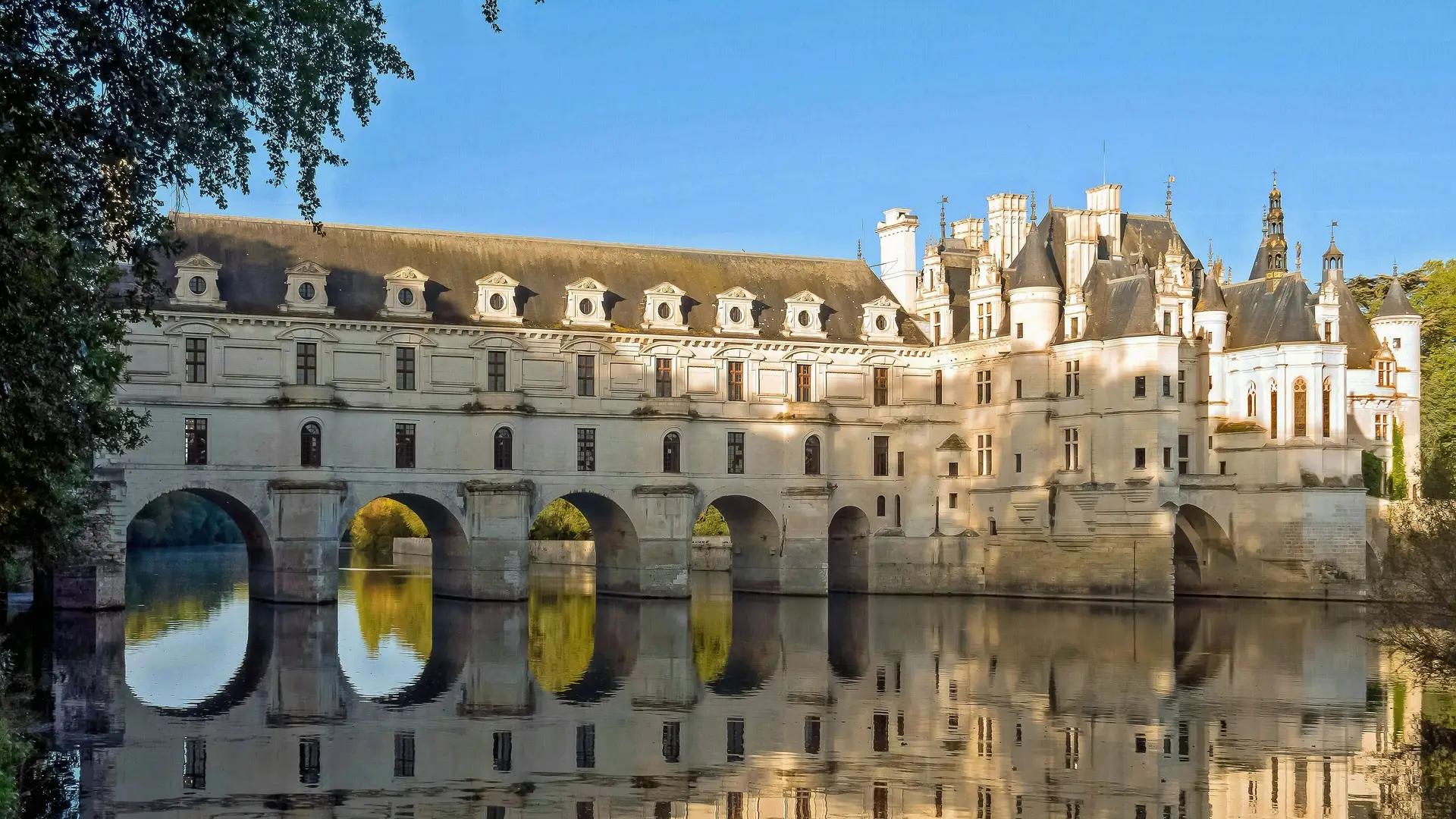
Chenonceau is the only Loire château built directly across a river — a piece of architectural ambition no other Renaissance French residence attempted. The five-arch bridge over the Cher carries a 60-metre two-storey gallery — Diane de Poitiers' bridge of 1556 designed by Philibert de l'Orme with Catherine de Medici's gallery layered on top from 1576 by Jean Bullant — and the composition is unique in French architecture. The original house, a square manor with round corner towers, is late Gothic transitioning into early French Renaissance, finished in 1521 by Katherine Briçonnet. The building reads as intimate, almost domestic, despite hosting French royal court life across the 16th century under three different female owners. The setting is a wooded river valley, the avenue of approach is 800 metres of plane trees, and the most-photographed exterior view is from the west bank of the Cher looking back at the five arches reflected in slow water.
Chambord is a different scale of ambition entirely and a different architectural genre. Begun by François I in 1519 — the same decade Chenonceau was being built by Katherine Briçonnet — and continued under successive kings into the 1680s, it was conceived as a royal hunting lodge but executed as the largest château in the Loire and one of the largest buildings of the French Renaissance. The principal façade runs 156 metres wide, the building rises through a fantastical roofscape of 282 chimneys, 426 rooms and 77 staircases including the famous double-helix central stair attributed in part to Leonardo da Vinci, and the entire ensemble sits inside a 5,440-hectare walled park — larger than central Paris in surface area — owned and administered by the French state. Where Chenonceau is a refined Renaissance house built across a river, Chambord is a fortress-scaled architectural statement set in a vast hunting estate.
Interiors: What You Actually See Inside
This is where the two châteaux diverge most sharply and where the comparison stops being symmetrical. Chenonceau's interiors are intact, furnished and densely period — six rooms in particular hold the visit together. The Long Gallery's lower floor is a black-and-white tile ballroom lit by 18 windows over the river. Catherine de Medici's bedroom and the Five Queens' Bedroom hold the densest concentration of 16th-century Flemish tapestries and painted coffered ceilings in the château. Diane de Poitiers' bedroom opens directly onto her formal garden through tall casement windows. Louise of Lorraine's mourning chamber on the upper floor is painted entirely black with white tears, skulls and knotted ropes — small, austere, and the most emotionally affecting room in the building. The service kitchens below are unusually intact, with original copper pans and a service bridge running out under the gallery to a river landing on the Cher.
Chambord, by contrast, is almost entirely unfurnished compared to Chenonceau. The building was never permanently inhabited as a residence — François I spent only 72 nights there in his entire reign, Louis XIV used it as a hunting lodge a century later, and most of the original furniture was removed during the French Revolution or sold off across the 19th century by successive owners. What you see today is the architecture itself: the double-helix staircase attributed to Leonardo, the soaring roof terraces with their forest of chimneys, the vaulted state rooms in cold stone, and a handful of recreated rooms with period furniture brought in for context by the state operator. The HistoPad tablet (also used at Chenonceau) helps reconstruct rooms as they once were. If you visit Chambord for furnished interiors and tapestries you will be disappointed; if you visit for architectural drama and royal-hunting-lodge scale, it delivers magnificently.
Gardens and Grounds
Chenonceau's two formal gardens — Diane de Poitiers' larger eastern parterre and Catherine de Medici's smaller western garden — are replanted seasonally by the Menier family's resident gardening team and run a year-round bloom calendar. Tulips peak in April, roses in May and June, the potager kitchen garden runs strong from April through October supplying the interior arrangements, and the maze of yew (planted 1996 to a 16th-century design) holds shape year-round. The grounds extend to a working farm with donkeys and goats, the Galerie des Dames wax-figure gallery in the Marques tower at the entrance, the vegetable and flower gardens, and the river walk along the south bank of the Cher. The total estate is compact enough that you can walk every part of it comfortably in an afternoon without rushing or skipping sections.
Chambord's grounds are an entirely different proposition and operate on a different visit logic. The 5,440-hectare walled park is the largest enclosed forest park in Europe, home to wild boar and red deer that are visible at dawn and dusk from the official observation hides scattered along the park trails. There is a formal French garden recreated on the north façade from a 2017 restoration project, but the gardens are not the headline draw — the headline is the wild park itself, which you can explore by hire bike, electric cart, rowing boat on the canals, or horse-drawn carriage ride. The scale means a full Chambord day can comfortably spend more time outside the château than inside it, which is closer to the original royal-hunting-estate experience than to a conventional furnished-château visit.
Crowds, Visit Time and Practicality
Both châteaux are busy in peak season but the pressure points differ noticeably between them. Chenonceau draws roughly 850,000 visitors a year and is most crowded between 11:00 and 15:00 from late June through August, when coach traffic from Paris and Tours peaks around lunch hours. The audio-guide tier sells out by mid-morning at peak season; arrival at 09:00 or after 16:00 buys near-empty rooms and short queues. The full visit takes 2.5 to 3 hours for the château and gardens, plus another hour for the farm and far estate. Chambord draws even more visitors — typically over 1.1 million a year — and the pressure window is broader, running 10:30 to 16:30, because of the longer drive from Paris. The full Chambord visit takes 2.5 to 3 hours for the château and roof terraces, plus easily another 2 hours for the park.
Two practical differences matter for day planners working out a Loire itinerary. Chenonceau is open every single day of the year except 25 December — the most generous calendar of any major Loire château — while Chambord follows a more standard French national-monument schedule with reduced winter hours and a small handful of additional closures on civic holidays. Chenonceau is privately owned by the Menier family through S.A.S. Château de Chenonceau and does not participate in the French Pass Culture or the Centre des monuments nationaux multi-pass; Chambord is state-owned and is included in those national programmes. The drive between them is about 50 minutes via the A85 motorway. Combining both in a single day is possible but tight — most visitors who try it report that one of the two felt rushed and ended in disappointment.
Which Should You Choose?
Choose Chenonceau if you value intact furnished interiors, intimate scale, a strong narrative thread (six women across four centuries), seasonal gardens at full bloom, the singular experience of walking a gallery built across a river, and the easiest train-to-château transfer in the entire Loire Valley. It is the stronger pick for first-time Loire visitors who want a single château that delivers architecture, interiors, gardens and a coherent story in one afternoon. It is also the stronger pick for travellers with mobility constraints on the train route — Chenonceaux station is five minutes' walk from the gate on a flat avenue of plane trees, and the official car park is sealed, free and immediately at the gate rather than a long walk away.
Choose Chambord if you value architectural scale and drama over furnished period rooms, want to explore a wild forest park as part of the visit, are drawn to the Leonardo da Vinci connection through the famous double-helix staircase, or want a hunting-lodge-grand experience that no other Loire château can match in scale. It is the stronger pick for repeat Loire visitors who have already done the more intimate châteaux on a previous trip, for families with children who want to bike or boat the park, and for visitors who measure châteaux on architectural ambition rather than on lived-in interiors. If you have two days in the Loire, do both: Chenonceau on day one, Chambord on day two, with a night in Amboise or Blois between them as a convenient lunch and overnight base.
Frequently asked
Is Chenonceau or Chambord more impressive?
They impress differently. Chambord is the bigger building and the more dramatic architectural statement; Chenonceau is the more intimate and furnished interior experience. For a single Loire château, Chenonceau is the stronger all-rounder; for pure architectural scale, Chambord wins.
Which is busier?
Both are very busy in peak season. Chambord draws over 1.1 million visitors a year, Chenonceau roughly 850,000. The pressure window is broader at Chambord (10:30–16:30) because of the longer drive from Paris; Chenonceau peaks tighter (11:00–15:00).
Can I visit both in one day?
Possible but tight. The two are 50 minutes apart via the A85 and each deserves at least 2.5 hours. The realistic pattern is Chenonceau morning, lunch in Amboise or Blois, Chambord afternoon — but most visitors who try it report one of the two felt rushed.
Which has better interiors?
Chenonceau, by a wide margin. Its rooms are furnished, intact and densely period; Chambord is almost entirely unfurnished because the building was never permanently inhabited. If you visit for interiors, Chenonceau is the clear pick.
Which has better gardens?
Chenonceau for formal gardens — two seasonal parterres replanted year-round by the Menier team. Chambord for wild parkland — a 5,440-hectare walled forest park with wild boar and deer. Different categories rather than directly comparable.
Which is easier to reach from Paris?
Chenonceau, by public transport. TGV Paris–Tours (1h15) then TER to Chenonceaux (25–30 min) — about 2 hours 45 minutes door-to-door. Chambord has no direct train station and requires a bus or taxi from Blois station, which adds friction.
Which is better for families with children?
Chambord for the park (bike hire, boats, deer-spotting), Chenonceau for the château itself (kitchens, maze, farm, HistoPad tablets). Under-7s enter free at both. For young children who tire of room-by-room visits, Chambord's outdoor element helps.
Which is open Christmas Day?
Neither. Chenonceau closes only on 25 December but is open every other day including Christmas Eve, Boxing Day and New Year's Day. Chambord follows a more standard French national-monument calendar with reduced winter hours.
Is one significantly more expensive?
Both are tiered with audio-guide and self-guided options, with discounts for under-18s, students and seniors. Chenonceau is privately owned and sets its own pricing; Chambord is state-owned and participates in the French Pass Culture. Current prices are on each operator's website.
Which has a stronger UNESCO connection?
Both sit inside the same UNESCO inscription — the Loire Valley between Sully-sur-Loire and Chalonnes, listed in 2000 (ref 933). Chambord was inscribed from the outset; Chenonceau was added to the inscribed zone on 9 July 2017 at UNESCO's 41st session in Krakow.