 Coupe-file disponible
 Que voir à l'intérieur du Château de Chenonceau
Un guide pièce par pièce de la Galerie des Dômes, des chambres de Diane et Catherine, de la chambre de deuil de Louise de Lorraine et des cuisines Renaissance intactes.
Chenonceau se mérite d'une lente déambulation plus que la plupart des châteaux de la Loire, car ses pièces sont intactes, meublées et densément d'époque — résultat d'une restauration des années 1860 financée par Marguerite Pelouze et d'un siècle de gestion minutieuse par la famille Menier. Le parcours libre complet couvre une quinzaine d'espaces nommés répartis sur deux étages principaux plus le niveau de service inférieur, et la plupart des visiteurs le bouclent en deux heures et demie à trois heures, jardins compris. Ce guide parcourt les pièces dans l'ordre où la plupart des visiteurs les découvrent, avec le contexte historique qui transforme chaque espace d'une pièce meublée en un témoignage de la vie de cour. Cinq pièces portent l'essentiel du poids — la Galerie des Dômes, la chambre de Catherine de Médicis, la chambre de Diane de Poitiers, la chambre de deuil de Louise de Lorraine et les cuisines de service — et le guide s'y attarde davantage.
La Galerie des Dômes sur le Cher
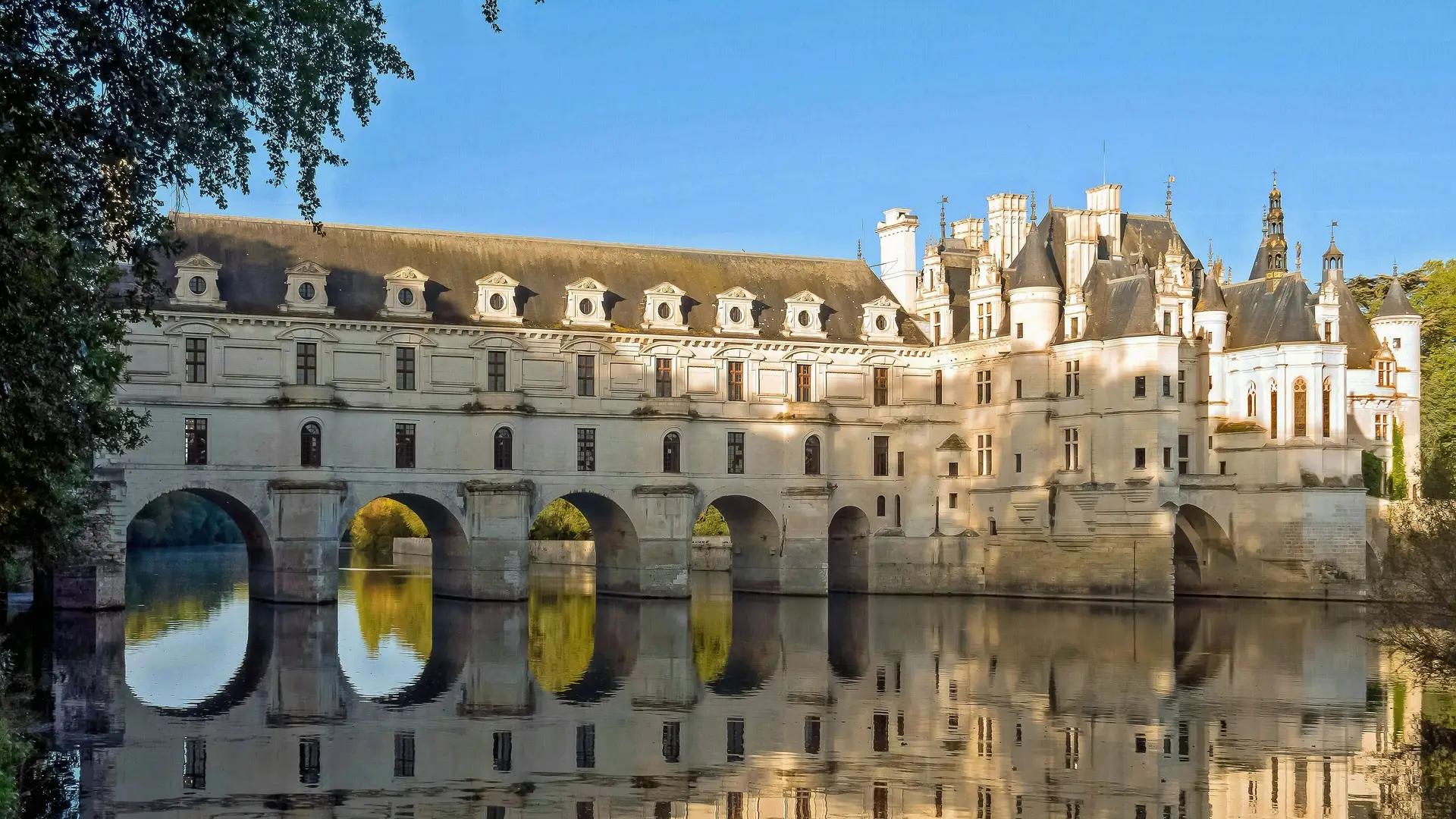
La Galerie des Dômes est l'intérieur phare et celui que la plupart des visiteurs photographient en premier. C'est une salle de 60 mètres sur deux niveaux, construite directement sur le pont à cinq arches de Diane de Poitiers enjambant le Cher. Catherine de Médicis commanda la galerie en 1570 à l'architecte Jean Bullant — quatorze ans après que Philibert de l'Orme eut conçu le pont en dessous — et la galerie fut achevée en 1576. Le niveau inférieur est une salle de bal ininterrompue pavée d'un damier d'ardoise noire et de pierre calcaire blanche de tuffeau, éclairée par 18 fenêtres de chaque côté qui encadrent la rivière coulant visiblement en dessous. Le niveau supérieur le reflète dans sa structure sinon dans son décor. Parcourez toute la longueur au niveau inférieur au moins une fois, idéalement deux (à l'aller et au retour), pour étudier la rivière à travers les fenêtres des deux côtés.
Deux moments ultérieurs rendent la galerie plus qu'une curiosité architecturale. Pendant la Première Guerre mondiale, la famille Menier convertit toute la galerie de 60 mètres en salle d'hôpital militaire à ses frais ; plus de 2 250 soldats français blessés y furent soignés entre 1914 et 1918, et des plaques murales commémorent encore ce rôle. Pendant la Seconde Guerre mondiale, le Cher lui-même formait une partie de la ligne de démarcation entre la France occupée par les nazis et la zone libre de Vichy — ce qui signifie que la porte sud de la galerie ouvrait sur la zone libre tandis que la porte nord ouvrait sur le territoire occupé. La famille Menier permit à la Résistance d'utiliser le château comme point de passage clandestin pour les réfugiés et les agents. Debout sur le sol de la galerie aujourd'hui, vous marchez à travers ces deux rôles du XXe siècle superposés à la vie de cour du XVIe siècle.
La Chambre et le Jardin de Diane de Poitiers
La chambre de Diane de Poitiers se trouve sur la façade sud, au-dessus de son pont, et est l'une des pièces qui ancrent le récit féminin du château sur le parcours des visiteurs. Henri II offrit Chenonceau à Diane en 1547, trois ans après son accession au trône ; elle avait vingt ans de plus que lui, était la femme la plus puissante de la cour de France, et elle conserva le château jusqu'à la mort d'Henri en 1559. La chambre donne directement sur le jardin à la française qu'elle a dessiné et commandé — le plus grand des deux parterres, conçu en quatre parterres triangulaires autour d'un bassin central, visible à travers les hautes fenêtres à meneaux du mur sud. La pièce contient une tapisserie flamande du XVIe siècle, un plafond à caissons sculpté et un portrait de Diane en déesse de la chasse. Le lit à baldaquin d'origine est garni de tentures restaurées lors de la restauration Pelouze des années 1860 qui a remodelé la plupart des intérieurs de l'étage supérieur.
Le contexte politique est difficile à exagérer lorsqu'on se tient dans cette pièce. Diane n'était pas simplement une maîtresse royale ; elle cogouvernait de facto le royaume pendant les douze ans du règne d'Henri II, intervenait dans la politique étrangère, signait des traités au nom du roi en son absence, et amassait des domaines et une fortune personnelle qui rivalisaient avec toute maison noble de France. Catherine de Médicis, la reine d'Henri, était tenue à l'écart du vrai pouvoir pendant que Diane le détenait — une humiliation que Catherine n'oublia jamais de sa vie. Quand Henri mourut d'une blessure de joute en 1559, Catherine força un échange en quelques semaines : Diane abandonna Chenonceau et reçut en retour le plus petit et moins prestigieux Château de Chaumont plus loin sur la rivière. La pièce où vous vous tenez aujourd'hui appartenait à une femme qui, brièvement et sans équivoque, fut la personne la plus puissante de France après le roi lui-même.
La Chambre de Catherine de Médicis et la Chambre des Cinq Reines
La chambre de Catherine de Médicis est l'une des pièces les plus richement décorées du château et abrite certaines de ses plus importantes tapisseries flamandes du XVIe siècle. Après avoir repris Chenonceau à Diane en 1559, Catherine en fit sa résidence principale pendant trente ans et y tint la cour royale durant les pires années des guerres de Religion françaises. Elle gouverna la France de fait à travers les règnes de trois fils Valois — François II (brièvement), Charles IX (comme régente pendant sa minorité) et Henri III — et ses décennies en tant que reine mère et régente façonnèrent la politique européenne de la fin du XVIe siècle plus qu'aucune autre figure. La chambre contient un lit à baldaquin sous un ciel de lit en tapisserie flamande du XVIe siècle, des murs tendus de tapisseries représentant des scènes bibliques, et un plafond à caissons peint avec le monogramme de Catherine répété dans les panneaux. La pièce est plus sombre que celle de Diane et semble plus chargée politiquement.
Sur le même palier se trouve la Chambre des Cinq Reines — ainsi nommée en l'honneur des cinq souveraines liées à Catherine par alliance : ses deux filles devenues reines (Margot, reine consort de France par Henri IV, et Élisabeth, reine consort d'Espagne par Philippe II) et trois belles-filles (Marie Stuart, qui épousa François II avant de devenir reine d'Écosse ; Élisabeth d'Autriche, reine consort de France ; et Louise de Lorraine, reine consort de France par Henri III). La pièce est ornée de six tapisseries flamandes du XVIe siècle et possède le plafond à caissons peints le plus élaboré du château, avec les armoiries de chaque reine reproduites dans les panneaux de bois au-dessus. Ensemble, la chambre de Catherine et la Chambre des Cinq Reines abritent la plus forte concentration de tapisseries flamandes du XVIe siècle de toute la vallée de la Loire.
Chambre de Deuil de Louise de Lorraine
La chambre de Louise de Lorraine, à l'étage supérieur, est petite, austère et, de loin, la pièce la plus émouvante du château. Louise hérita de Chenonceau de Catherine de Médicis en 1589, après la mort de celle-ci en janvier de la même année et l'assassinat de son époux Henri III quelques mois plus tard, en août, par un fanatique catholique. Henri fut le dernier roi Valois de France ; son assassinat mit fin à la dynastie et déclencha la crise de succession qui, après des années de guerre civile, porta finalement Henri IV et les Bourbons au trône. Louise avait 36 ans lorsqu'elle devint veuve. Elle se retira définitivement à Chenonceau, prononça des vœux de deuil formels et vécut dans cette seule pièce jusqu'à sa mort en 1601 — onze années passées presque entièrement recluse dans le château, pleurant son mari.
La pièce est entièrement peinte en noir, du sol au plafond. Les murs, le plafond et les panneaux de bois d'origine sont couverts de symboles de deuil — larmes blanches peintes, crânes blancs, cordes blanches nouées (représentant le cingulum des robes religieuses des veuves), la lettre H entrelacée avec la lettre grecque lambda (la lettre de Louise), et des couronnes d'épines. La décoration peinte originale du XVIe siècle est partiellement préservée et partiellement restaurée après des repeints ultérieurs. Il y a un lit simple, un petit prie-Dieu pour la prière et une fenêtre donnant sur les jardins qu'elle parcourait rarement de son vivant. Il ne faut que deux ou trois minutes pour voir la pièce, mais c'est l'espace le plus saisissant du château, et il est facile de le dépasser lors d'une visite rapide — prenez le temps de vous y attarder, idéalement avec le commentaire audio-guide, qui reconstitue le contexte émotionnel et politique derrière la décoration.
Les Cuisines de la Renaissance en contrebas
Les cuisines de service se trouvent sous le rez-de-chaussée et sont exceptionnellement intactes pour un château de la Renaissance — la plupart des espaces de service équivalents dans les résidences royales françaises ont été détruits ou modernisés au cours des XVIIIe et XIXe siècles. À Chenonceau, l'agencement d'origine subsiste : la cuisine principale avec sa cheminée ouverte et ses rangées de casseroles en cuivre accrochées à des crochets en fer, la boucherie avec ses crochets à viande et ses billots, le four à pain, la salle à manger du personnel où les domestiques mangeaient en commun, les garde-manger pour les viandes salées et les denrées sèches, et le pont de service qui s'étend sous la galerie jusqu'à un petit débarcadère sur le Cher. Les provisions étaient autrefois déchargées directement des bateaux fluviaux à ce débarcadère — vin, grain, poisson, gibier — et hissées dans les salles de service au-dessus.
Deux éléments pratiques rendent les cuisines dignes d'un véritable intérêt plutôt que d'un simple passage. Premièrement, l'équipement est de la véritable vaisselle d'époque, et non une reproduction : les casseroles en cuivre, les chenets en fer, les mécanismes de rôtissage à la broche, les armoires à épices et les outils de boulangerie sont des stocks de travail des XVIIe et XVIIIe siècles, collectés dans le domaine ou acquis par la famille Menier. Deuxièmement, les cuisines ont été utilisées en continu jusqu'au XXe siècle — pendant la période de l'hôpital de la Première Guerre mondiale, la salle à manger du personnel nourrissait le personnel chirurgical et le four à pain cuisait pour les salles au-dessus. Les cuisines sont également l'un des espaces où les tablettes de reconstruction 3D HistoPad fonctionnent le mieux, superposant l'aspect de la pièce sous Catherine de Médicis à ce que vous voyez aujourd'hui.
La Chapelle, la Galerie des Dames et autres espaces
Plusieurs espaces plus petits complètent la visite. La chapelle au rez-de-chaussée est un petit oratoire Renaissance intact avec une voûte en pierre d'origine, un vitrail restauré au XXe siècle après les dommages de guerre, et un graffiti gravé dans le cadre de la porte par un garde écossais du XVIe siècle de la maison de Marie Stuart — Marie a vécu brièvement à Chenonceau pendant son court mariage avec François II. La tour Marques à l'entrée abrite la Galerie des Dames, une galerie de tableaux de figures en cire qui guide les visiteurs à travers les six femmes qui ont façonné le château pendant quatre siècles : Katherine Briçonnet, Diane de Poitiers, Catherine de Médicis, Louise de Lorraine, Madame Dupin et Marguerite Pelouze. La Galerie est un ajout rapide de quinze minutes et un résumé utile si vous la visitez en début de journée.
Parmi les autres pièces nommées qui méritent une attention particulière figurent le hall d'entrée — son plafond bas à voûtes d'ogives est l'intérieur le plus ancien préservé du bâtiment, datant de la construction originale de 1513 à 1521 — et le Cabinet Vert au rez-de-chaussée, qui était le bureau de travail de Catherine de Médicis où elle recevait les ambassadeurs et signait les papiers d'État pendant sa régence. Le salon François Ier contient un portrait du roi qui s'empara du château après la mort de Thomas Bohier en 1524, et un cassone (coffre de mariage) italien du XVIe siècle avec des panneaux peints. La galerie de l'étage supérieur — directement au-dessus du rez-de-chaussée de la Grande Galerie — est moins visitée et moins fréquentée ; parcourez-la pour les vues sur la rivière d'un côté et les jardins de l'autre, et pour les poutres peintes du plafond.
Questions fréquentes
Quelle est la pièce la plus impressionnante de Chenonceau ?
La Grande Galerie au-dessus du Cher est le clou du spectacle — 60 mètres de long, deux étages, construite au-dessus de la rivière. La chambre de Catherine de Médicis, la Chambre des Cinq Reines et la chambre de deuil peinte en noir de Louise de Lorraine sont les pièces intérieures les plus saisissantes.
Les cuisines valent-elles le détour ?
Oui. Les cuisines de service Renaissance, situées sous le rez-de-chaussée, sont exceptionnellement préservées, avec leurs casseroles en cuivre d’origine, le four à pain, la boucherie, la salle à manger du personnel et la passerelle de service qui mène à un embarcadère sur le Cher. Elles comptent parmi les moments forts de la visite.
Puis-je parcourir toute la longueur de la Galerie des Dames ?
Oui — le niveau inférieur de la galerie forme une salle de bal ininterrompue de 60 mètres, pavée de carreaux noirs et blancs, éclairée par 18 fenêtres de chaque côté. Parcourez-la dans un sens puis dans l’autre au moins une fois. L’étage supérieur est également accessible par un escalier.
La chambre de Louise de Lorraine est-elle vraiment peinte en noir ?
Oui. Les murs, le plafond et les lambris sont peints en noir, parsemés de larmes blanches, de crânes blancs, de cordes nouées et de couronnes d’épines — les symboles du deuil d’une veuve. Louise y vécut onze ans après l’assassinat de son époux Henri III.
Chenonceau a-t-il servi d’hôpital pendant la Première Guerre mondiale ?
Oui. La famille Menier a transformé l’intégralité de la Galerie des Dames, longue de 60 mètres, en salle d’hôpital militaire à ses frais. Plus de 2 250 soldats français blessés y furent soignés entre 1914 et 1918. Des plaques commémoratives dans la galerie rappellent ce rôle.
Les pièces sont-elles meublées ou vides ?
Meublées, et richement. Chenonceau est l’un des rares grands châteaux de la Loire à posséder des intérieurs d’époque intacts — tapisseries flamandes du XVIe siècle, lits d’origine avec leurs courtines restaurées, plafonds à caissons peints, équipements de cuisine fonctionnels, et une chapelle avec sa voûte Renaissance d’origine.
Qu’est-ce que le HistoPad ?
Une tablette qui superpose des reconstitutions 3D de chaque grande pièce telle qu’elle était sous Catherine de Médicis au XVIe siècle, vendue en supplément à l’entrée. Elle fonctionne particulièrement bien dans les cuisines, la Galerie des Dames et les appartements royaux, et est disponible dans environ 11 langues.
Combien de temps dure la visite de l'intérieur ?
Environ 2 à 2h30 à un rythme confortable, en parcourant toutes les salles nommées aux deux étages ainsi que les cuisines. Moins d'1h30 donne une impression de précipitation ; plus de 3 heures est inhabituel, sauf si vous passez un long moment avec l'audioguide dans chaque espace.
La photographie est-elle autorisée à l'intérieur ?
Oui — les photos personnelles sans flash sont autorisées dans tout le château. Trépieds, éclairages, drones et tout matériel professionnel nécessitent une autorisation préalable de l'opérateur. La plupart des pièces intérieures bénéficient d'une lumière naturelle suffisante grâce aux fenêtres Renaissance pour des prises de vue à main levée.
Quelle salle est la plus facile à manquer par inadvertance ?
La chambre de deuil de Louise de Lorraine à l'étage supérieur. Petite et silencieuse, on la traverse d'un regard en 30 secondes, mais c'est la pièce la plus émouvante du bâtiment et elle mérite trois ou quatre minutes avec les commentaires de l'audioguide.