 Skip-the-line available
 The Ladies' Château: Six Women Who Shaped Chenonceau
Katherine Briçonnet, Diane de Poitiers, Catherine de Medici, Louise of Lorraine, Madame Dupin and Marguerite Pelouze — four centuries of women-led stewardship.
Chenonceau is called Le Château des Dames — the Ladies' Château — because six women shaped it across four centuries in a way no other major French château can claim. Each left specific architectural, decorative or political marks that are still visible in the building today: a room, a garden, a bridge, a salon, a restored façade. The succession is not metaphor or marketing — it is a documented chain of female owners, builders, regents, salonnières and patrons, with their husbands either dead, absent, exiled or politically irrelevant during the years that mattered. This guide walks through the six in chronological order, with the architectural and political context that explains why their names are the ones attached to the rooms you walk through today.
Katherine Briçonnet — the Original Builder, 1513–1521
Katherine Briçonnet was the wife of Thomas Bohier, a royal financier and treasurer to Charles VIII and Louis XII. Bohier acquired the Chenonceau estate in 1513 from the Marques family and immediately began demolishing the existing medieval fortified manor to build a Renaissance house in its place. Thomas was on near-continuous military campaign in Italy during the construction years — Italy was the centre of the European Renaissance, and French nobles were drafted into the Italian Wars under Francis I — and Katherine supervised the build directly from 1513 to 1521. The square manor with four round corner towers that forms the core of the château you see today is hers; it is one of the earliest surviving French Renaissance residences, and the daily organisation around domestic and social space rather than military defence dates from her hand.
Her tenure ended in failure. Thomas died in 1524 and a royal audit found the Bohier estate massively in debt to the crown for unpaid taxes. Their son Antoine was forced to surrender Chenonceau to Francis I in 1535 in lieu of the debt, ending the family's ownership barely two decades after Katherine had built the house. The château became royal property and entered the second phase of its history under Henry II and his mistress. Katherine's name is inscribed on the entrance hall ceiling along with a Latin motto — S'il vient à point, me souviendra (If it is completed, I will be remembered) — and the modern visitor route opens with that ceiling, the oldest preserved interior in the building, dating from her construction of 1513–1521.
Diane de Poitiers — Mistress of the King, 1547–1559
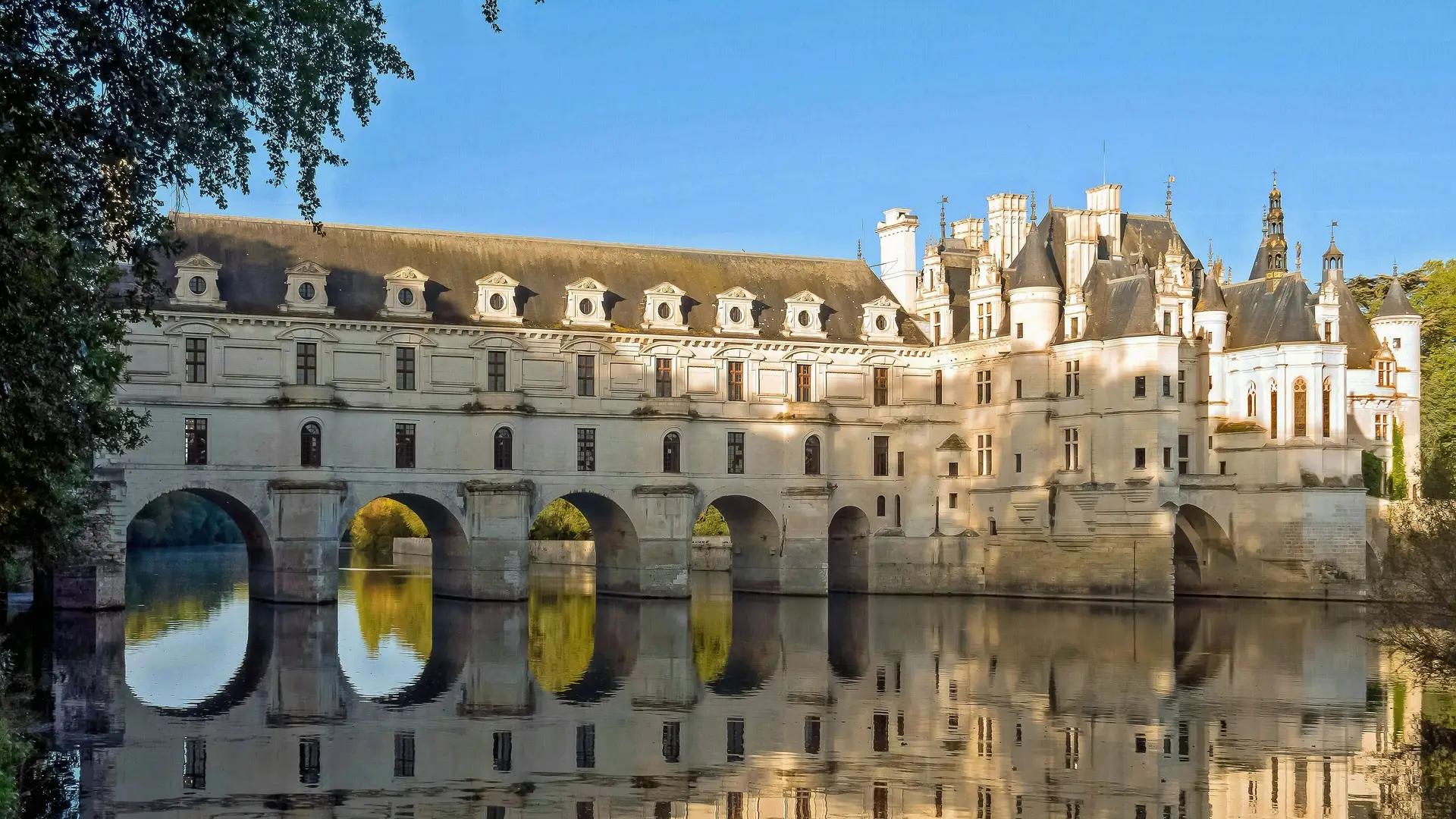
Diane de Poitiers received Chenonceau as a gift from Henry II in 1547, three years after he took the throne. She was twenty years his senior, his lifelong mistress from his teenage years onward, the most powerful woman at the French court, and an unusually competent administrator of estates and finances. At Chenonceau she commissioned the larger of the two formal gardens — laid out in four triangular parterres around a central fountain, designed to be visible from her bedroom on the south façade — and the celebrated bridge across the River Cher, designed by Philibert de l'Orme between 1556 and 1559. The bridge was a piece of architectural ambition unmatched at any other Loire château: five stone arches carrying a gallery base across the full width of the river.
Her political role was more substantial than the term royal mistress suggests. Diane effectively co-ran the realm during Henry's twelve-year reign — she signed treaties on the king's behalf in his absence, intervened in foreign policy, controlled access to the king, and amassed estates and wealth that rivalled any noble house in France. Catherine de Medici, Henry's queen, was kept at a distance from real power while Diane held it. When Henry died from a jousting wound in 1559, Catherine forced an exchange within weeks: Diane gave up Chenonceau and received the smaller, less prestigious Château de Chaumont in return. Diane's room and her garden survive at Chenonceau today, and the bridge she commissioned is the structural base of everything Catherine later added on top.
Catherine de Medici — Queen Regent, 1559–1589
Catherine de Medici took Chenonceau back from Diane within weeks of Henry II's death and held it as her primary residence and political base for thirty years. She ruled France in effect across the reigns of three Valois sons — Francis II (briefly), Charles IX (whose minority she controlled as regent), and Henry III — and her decades as Queen Mother shaped late 16th-century European politics more than any other single figure. From 1570 to 1576 she commissioned architect Jean Bullant to build the two-storey gallery on top of Diane's bridge — the 60-metre Long Gallery you walk today — turning the bridge into the architectural centrepiece of the château. The gallery hosted lavish parties including the first recorded fireworks display in France, staged for her son Francis II in 1560.
Catherine's bedroom and the adjacent Five Queens' Bedroom on the upper floor hold the densest concentration of 16th-century Flemish tapestry weaving in the Loire Valley. Her Green Cabinet on the ground floor was her working office, where she received ambassadors and signed state papers during her regency. The chronology is hard to overstate: while Catherine was at Chenonceau, France went through eight Wars of Religion, the St Bartholomew's Day Massacre of 1572 (which she at least partly orchestrated), and the slow collapse of the Valois dynasty that ended with her son Henry III's assassination a few months after her own death in 1589. The building you walk through is her stage as much as Diane's, and the two women's rivalry — bridge vs gallery — is the architectural through-line of the entire property.
Louise of Lorraine — the Widow in Black, 1589–1601
Louise of Lorraine inherited Chenonceau from her mother-in-law Catherine on Catherine's death in 1589. She was queen consort of France through her marriage to Henry III, the last Valois king. Henry was assassinated by a Catholic fanatic in August 1589, a few months after Catherine's death — ending the dynasty and triggering the succession crisis that brought Henry IV and the Bourbons to the throne. Louise was 36 when she was widowed. She retired permanently to Chenonceau, took mourning vows, dressed in white (the colour of royal widowhood in France rather than black), and lived in a single upper-floor room until her death in 1601 — eleven years almost entirely shut inside the château grieving for her husband.
Her room on the upper floor is painted entirely black, with white tears, white skulls, knotted ropes (the cingulum of widows' robes), the letter H entwined with the Greek letter lambda (for Louise), and crowns of thorns covering the walls and ceiling. The original painted decoration is partially preserved and restored. There is a single bed, a small kneeler for prayer, and a window that overlooks the gardens she rarely walked. The room takes only two or three minutes to see but is the most striking single space in the château — easy to walk past in a quick visit, and the one most repeat visitors say stays with them longest. Louise had no surviving children with Henry III, and the château passed out of royal hands on her death.
Madame Dupin — Enlightenment Salonnière, 1733–1799
After more than a century of declining royal use and a succession of indifferent owners, Chenonceau was bought in 1733 by Claude Dupin, a wealthy farmer-general (tax collector for the crown), and his wife Louise Dupin. Madame Dupin was the dominant force in the partnership. Across the middle decades of the 18th century she ran one of the most influential literary salons of the French Enlightenment from the château, drawing Voltaire, Montesquieu, Buffon, Marivaux, Fontenelle and Jean-Jacques Rousseau — who lived at Chenonceau for extended periods as tutor to her son Chenonceaux Dupin and worked on his treatise Émile partly while in residence. The drawing rooms on the ground floor that you walk today were her salon spaces, and the library upstairs still contains some of her original holdings.
Her most consequential act was political rather than literary. During the French Revolution, when angry mobs across the Loire and the wider Touraine systematically attacked, looted and burned the châteaux of the aristocracy as symbols of the ancien régime, Madame Dupin persuaded her village to spare Chenonceau on the grounds that the bridge across the Cher was the only crossing for kilometres in either direction and was essential to the local economy. The village agreed. The château survived the Revolution structurally intact while several neighbouring properties — including the royal château at Chambord, which was looted and partially stripped — suffered serious damage. Madame Dupin died at Chenonceau in 1799 aged 93, and is buried in a quiet grove on the estate.
Marguerite Pelouze — the Victorian Restorer, 1864–1888
Marguerite Pelouze was the daughter of a wealthy industrialist who bought Chenonceau in 1864 and undertook an ambitious — sometimes overzealous — restoration that returned much of the interior to a romanticised Renaissance state. She hired the architect Félix Roguet, removed several 18th-century additions that did not fit the Renaissance narrative, restored the painted coffered ceilings, rehung the rooms with 16th-century Flemish tapestries acquired on the European art market, and refurnished the bedrooms with period beds and hangings. The restoration was expensive and not universally praised — modern conservation practice would consider some of her interventions excessive — but the rooms you walk today are largely the version of Chenonceau that emerged from her decades of work.
Her tenure ended badly. The restoration costs combined with her brother's failed political career bankrupted the family, and Chenonceau was seized by creditors in 1888 and passed through a brief succession of owners — including the Cuban industrialist José-Emilio Terry and the Frenchman Henri Menier of the chocolate dynasty — before stabilising under Henri's brother Gaston Menier, who completed the purchase in 1913. The Menier family has owned and operated the château ever since through the company S.A.S. Château de Chenonceau, funding restoration and visitor services entirely from ticket revenue rather than the French state budget. Marguerite Pelouze is the sixth and last of the Ladies in the standard count — though, properly speaking, Gaston Menier's daughters and granddaughters have continued the female-led stewardship line into the present.
Frequently asked
Why is Chenonceau called the Ladies' Château?
Because six women shaped it across four centuries — Katherine Briçonnet, Diane de Poitiers, Catherine de Medici, Louise of Lorraine, Madame Dupin and Marguerite Pelouze. Each left specific architectural, decorative or political marks that are still visible in the building today. No other major French château has the same continuous female-led ownership and stewardship history.
Who built the original house?
Katherine Briçonnet, between 1513 and 1521, while her husband Thomas Bohier was on military campaign in Italy. The square manor with four round corner towers that forms the core of the château today is hers, including the entrance hall ceiling — the oldest preserved interior in the building.
Who built the bridge across the Cher?
Diane de Poitiers, between 1556 and 1559, designed by architect Philibert de l'Orme. The bridge is five stone arches across the full width of the River Cher and is the structural base of the later Long Gallery.
Who built the Long Gallery on top of the bridge?
Catherine de Medici, between 1570 and 1576, designed by architect Jean Bullant. The two-storey gallery sits directly on top of Diane's bridge and is 60 metres long. Catherine built it after forcing Diane to exchange Chenonceau for Chaumont in 1559.
Why was Louise of Lorraine's room painted black?
Louise was the widow of Henry III, the last Valois king, who was assassinated in 1589. She retired permanently to Chenonceau, took mourning vows and lived in the single upper-floor room until her death in 1601. The black walls, white tears, white skulls and knotted ropes are mourning symbols.
Who was Madame Dupin?
Louise Dupin, who acquired Chenonceau in 1733 with her husband Claude Dupin. She ran one of the most influential literary salons of the French Enlightenment, drawing Voltaire, Montesquieu, Buffon and Rousseau (who tutored her son). She is credited with persuading her village to spare the château during the Revolution.
Did the château survive the French Revolution?
Yes — almost uniquely among major royal-associated châteaux. Madame Dupin convinced her village to spare it because the bridge was the only Cher crossing for kilometres. While neighbouring châteaux including Chambord were looted, Chenonceau survived the Revolution structurally intact.
Who is the Menier family?
The 19th-century chocolate dynasty behind the Chocolat Menier brand. Gaston Menier bought Chenonceau in 1913 and the family has owned and operated it ever since through the company S.A.S. Château de Chenonceau. Restoration and visitor services are funded entirely from ticket revenue.
Is the women-led story marketing or real history?
Real history. Each of the six women is documented in French archival sources — wills, contracts, royal correspondence, the Pelouze restoration accounts. Diane's and Catherine's roles in particular are the subject of substantial French and English-language scholarship. The named rooms in the château today bear the names of the women, not their husbands.
Where can I see all six women summarised in one place?
The Galerie des Dames in the Marques tower at the château entrance — a wax-figure tableau gallery dedicated to the six women — is the operator's own summary and a useful 15-minute walkthrough if you visit it at the start of the day before the main rooms.